UEFA Specialist Coaching Licences Explained: Youth, Goalkeeper and Fitness
UEFA offers specialist coaching qualifications for coaches working in youth development, goalkeeping and football fitness. These courses build on the main UEFA licensing pathway and provide training for more specific coaching responsibilities.
The right qualification depends on your role, the players you work with and your existing coaching experience. Some specialist courses are available after UEFA C, while others require UEFA B, UEFA A or previous specialist qualifications.
These are not replacements for the standard UEFA C, B, A and Pro pathway. They provide additional education for coaches who want to develop expertise in a particular area. If you're unfamiliar with the main qualifications, start with our guide to UEFA coaching licences.
Which specialist UEFA coaching licences are available?
The 2025 UEFA Coaching Convention establishes six specialist diplomas across youth development, goalkeeping and fitness.
| Qualification | Main focus | Minimum contact hours |
|---|---|---|
| UEFA Youth B | Developing talented young players | 60 |
| UEFA Elite Youth A | Preparing elite youth players for professional football | 120 |
| UEFA Goalkeeper B | Developing youth and adult goalkeepers | 60 |
| UEFA Goalkeeper A | Goalkeeper coaching in professional football | 120 |
| UEFA Fitness B | Physical preparation and performance development | 120 |
| UEFA Fitness A | Advanced physical performance coaching | 180 |
These figures are the minimum contact hours specified in Article 28 of the convention. They include supervised learning and practical work experience, not just classroom teaching. National associations may offer longer programmes.
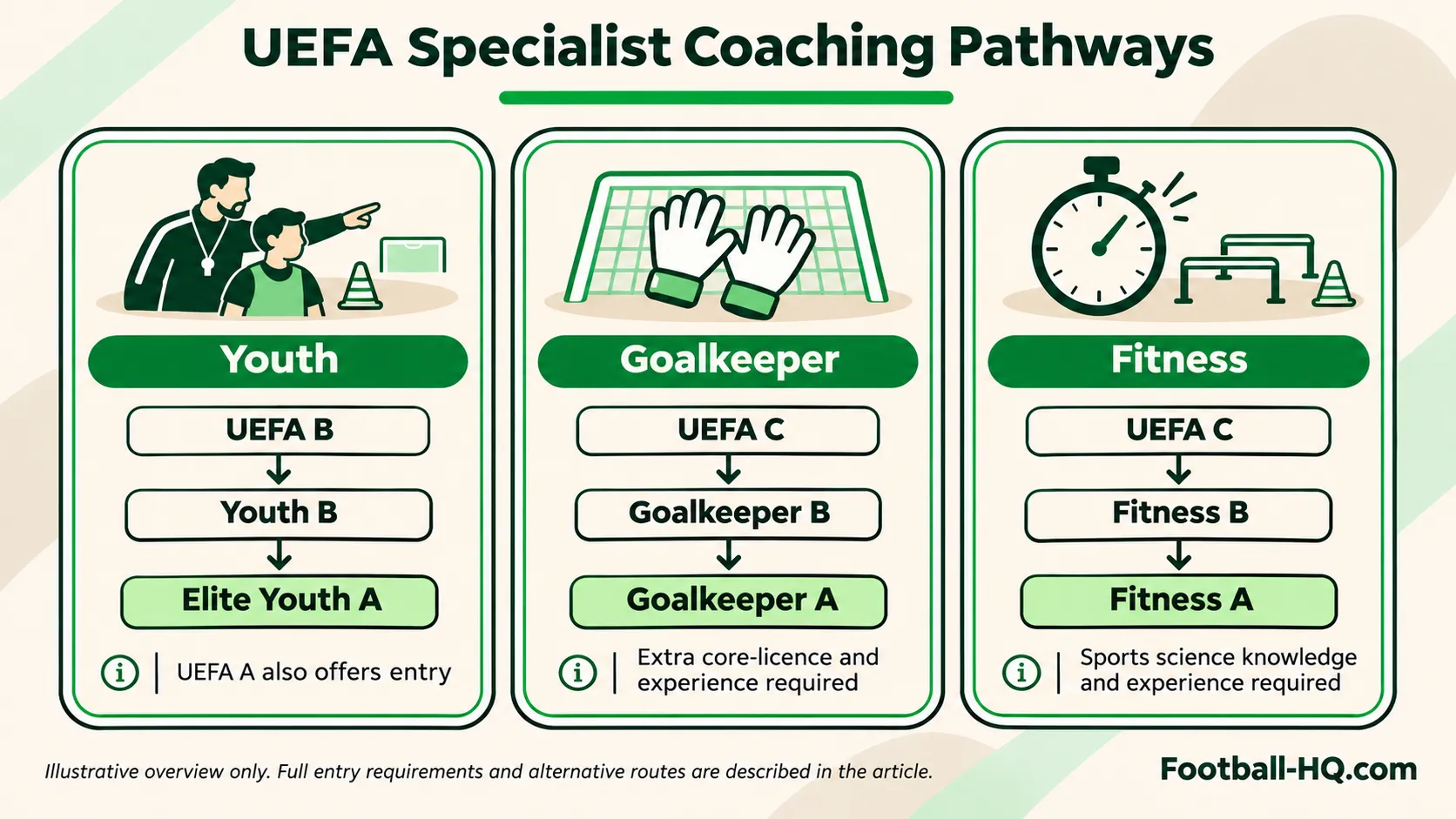
UEFA's three specialist coaching pathways have different entry requirements. Youth B requires UEFA B, while Elite Youth A requires either UEFA A or Youth B plus one year's coaching experience. Goalkeeper B requires UEFA C and six months' relevant experience; Goalkeeper A requires UEFA Pro, or both UEFA B and Goalkeeper B, plus one year's specialist experience. Fitness B requires UEFA C or Futsal C, six months' fitness coaching experience and bachelor-level sports science knowledge. Fitness A requires Fitness B, another year's experience and the same academic knowledge. National associations may impose additional requirements.
UEFA Youth B and Elite Youth A licences
The UEFA youth pathway is designed for coaches working with talented young players, particularly those progressing towards academy and professional football.
UEFA Youth B
The UEFA Youth B diploma focuses on developing players moving from grassroots or amateur football into more demanding youth environments.
Coaches study player development, training design and the physical and psychological changes that occur as young players mature. The aim is to help coaches understand how to develop individuals rather than simply prepare a team to win its next match.
Entry requirement: A valid UEFA B licence.
Minimum education: 60 contact hours.
For example, a coach working with talented young teenagers could use this qualification to improve how training challenges players at different stages of development.
UEFA Elite Youth A
The UEFA Elite Youth A diploma focuses on players approaching senior professional football. It covers individual development plans, high-performance training, match preparation and working within a professional academy structure.
Under Article 21 of the convention, applicants must meet one of two routes:
- Hold a valid UEFA Youth B licence and have completed at least one year's experience as a head or assistant coach since graduating.
- Hold a valid UEFA A licence.
Minimum education: 120 contact hours.
UEFA also permits combined UEFA A and Elite Youth A courses. These require a valid UEFA B licence and at least one year's experience after UEFA B as a head or assistant coach in 11-a-side football. The combined programme has a minimum of 300 contact hours.
The Scottish FA's Elite Youth A course provides a practical example. Its programme includes online learning, club-based coaching assignments, recorded training sessions and an academy study visit.
UEFA Goalkeeper B and Goalkeeper A licences
Goalkeeping requires specialist training because the position involves different technical actions, physical demands and decisions from those of outfield players.
UEFA's goalkeeper pathway helps coaches design position-specific sessions and develop goalkeepers within the team's overall playing approach.
UEFA Goalkeeper B
This qualification focuses on developing young goalkeepers and coaching adults in amateur or elite environments. Training covers technical execution, positioning, decision-making and how goalkeepers contribute to different phases of play.
Under Article 24, applicants must:
- Hold a valid UEFA C licence.
- Have completed at least six months of experience as a goalkeeper coach after graduating with UEFA C.
Minimum education: 60 contact hours.
The FAW's Goalkeepers B course combines online webinars with in-person education. It requires applicants to provide a coaching CV, club support letter and evidence of their UEFA C qualification.
UEFA Goalkeeper A
The advanced qualification prepares coaches to work with goalkeepers in professional football. It develops skills in performance analysis, individual development, advanced tactics and collaboration with the wider coaching staff.
Article 25 of the 2025 convention sets two possible entry routes:
- Hold a valid UEFA Pro licence; or
- Hold both a valid UEFA B licence and UEFA Goalkeeper B licence.
In either case, candidates must also have completed at least one year's experience as a goalkeeper coach in 11-a-side football after obtaining the qualifying UEFA Pro or Goalkeeper B licence.
Minimum education: 120 contact hours.
The FAW's Goalkeepers A programme includes practical assessments, club-based mentoring and learning about technical, tactical, physical and mental goalkeeper development.
UEFA Fitness B and Fitness A licences
UEFA's fitness qualifications focus on preparing footballers for the physical demands of training and competition. They are designed for coaches involved in physical performance, workload management and player development.
This pathway is relatively new. The Scottish FA piloted the UEFA Football Fitness B Licence in 2024, with the first group completing a programme combining sports science with practical coaching.
UEFA Fitness B
The UEFA Fitness B diploma develops a coach's understanding of physical preparation in football, including training loads, player development and applying sports science to practical sessions.
Article 26 requires applicants to:
- Hold a valid UEFA C or UEFA Futsal C licence.
- Have completed at least six months of experience as a fitness coach in football or futsal after graduating with that licence.
- Have bachelor-level knowledge of sports science or exercise science.
Minimum education: 120 contact hours.
The convention specifies a level of academic knowledge, not explicitly a particular degree certificate. Individual associations determine how applicants demonstrate that knowledge and may require supporting academic evidence.
UEFA Fitness A
UEFA Fitness A builds on the B qualification, focusing on more advanced physical performance responsibilities within football or futsal.
Under Article 27, applicants normally need a valid UEFA Fitness B licence, at least one year's relevant experience after obtaining it, and bachelor-level sports or exercise science knowledge.
Minimum education: 180 contact hours.
The convention also permits a temporary direct-entry route for certain experienced fitness coaches during an association's initial rollout of Fitness B or A. This exception has specific professional experience requirements and is not a general exemption from the normal pathway.
Do you need a specialist licence to coach professionally?
Not every specialist coaching position requires the same UEFA qualification. Requirements depend on the club's competition, the national association and the responsibilities of the role.
The 2026 UEFA Club Licensing and Financial Sustainability Regulations provide examples for clubs covered by that licensing system.
Under Article 49, a first-team goalkeeper coach must hold the highest available relevant UEFA goalkeeper licence for the association's convention status, or recognised equivalent competence. Article 52 sets a different standard for youth goalkeeper coaches, allowing the second-highest available UEFA goalkeeper qualification, an accepted domestic goalkeeper licence or recognised equivalent competence.
For youth development, Articles 50 and 51 recognise several qualifications depending on the position and association's convention status. These can include Elite Youth A, UEFA A, UEFA B or Youth B. An Elite Youth A licence is not universally required for every professional academy role.
Fitness coaches should similarly check the applicable competition and employment requirements. Holding a UEFA Fitness qualification may be valuable, but the convention itself does not make Fitness A compulsory for every professional fitness coaching position.
Where can you take UEFA specialist coaching courses?
Specialist courses are delivered by national football associations and their authorised providers. Availability varies between countries, and some advanced courses have limited places or specific application periods.
Useful starting points include the Scottish FA's UEFA coaching pathways, which cover youth, goalkeeper and fitness education, and FAW Coach Education, which publishes specialist goalkeeper courses.
Before applying, confirm that you meet the prerequisites and check the course's language, duration, price and practical coaching requirements.
Article 16 of the convention requires applicants to demonstrate that they will have "access to a team of the required level" for practical assignments. This can be important if you're studying abroad or do not currently coach in the environment required by the course.
If your existing UEFA qualification was issued by another convention signatory, you must also complete the official cross-border education form when applying for further UEFA diploma education through a different association.
Our UEFA coaching licence application guide explains the general application process. For budgeting, see our comparison of football coaching licence costs.
Which specialist qualification should you choose?
The most relevant pathway depends on your current responsibilities and where you want to work.
- Youth B or Elite Youth A: For coaches developing talented young players, particularly in academy environments.
- Goalkeeper B or A: For coaches responsible for goalkeeper development, from youth football to professional teams.
- Fitness B or A: For coaches specialising in physical preparation, sports science and performance development.
Start by checking which qualifications your intended role actually requires. There is little reason to pursue an advanced specialist course before gaining the coaching experience needed to benefit from it.
Like other UEFA coaching qualifications, specialist licences must also be kept valid through recognised continuing education. Our UEFA licence renewal guide explains the three-year renewal cycle and CPD requirements.
If you're already coaching a team, you can practise organising and adapting your sessions with FootballHQ's free drill creator, including position-specific exercises for goalkeepers and youth players.