
How to Get a UEFA Coaching Licence

To get a UEFA coaching licence, start by finding an officially recognised coaching course through a UEFA member association. If you're new to coaching, you'll normally begin with an introductory course or the UEFA C pathway before progressing to more advanced qualifications.
You don't need to have played professionally to get started. Many courses are designed for grassroots coaches and volunteers who want to improve how they plan sessions, communicate with players and support their development.
Although UEFA sets common qualification standards, individual football associations organise the courses and determine their admission requirements. You can explore courses in your own country or abroad, provided you meet the organiser's conditions.
Coaching in the United States? The qualification system is different. See our guide to getting a soccer coaching license in the USA.
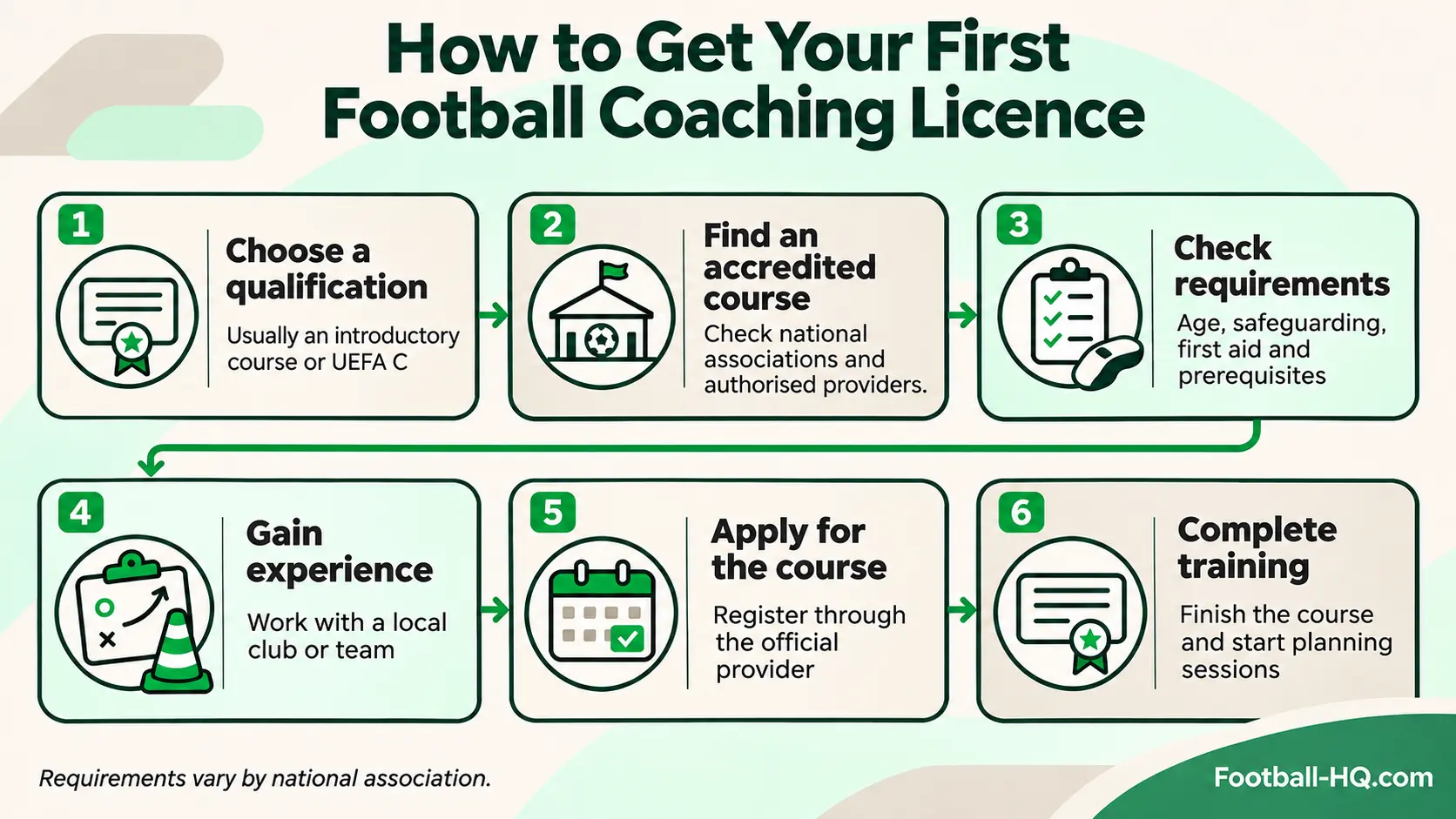
The general process of obtaining a UEFA coaching licence. Entry requirements and application procedures vary between national football associations.
Step 1: Choose the right UEFA coaching qualification
Your first course should match your experience and the level at which you want to coach.
UEFA's main coaching pathway has four levels:
| Qualification | Main focus |
|---|---|
| UEFA C | Grassroots and introductory youth coaching |
| UEFA B | Player development and team performance |
| UEFA A | Advanced coaching and match preparation |
| UEFA Pro | Professional head coaching and leadership |
Most beginners should explore UEFA C or any introductory courses required by their chosen association. Higher qualifications normally require previous licences and practical coaching experience.
For a detailed comparison, including minimum course hours and progression requirements, read our guide to UEFA coaching licences.
If you're starting with a local youth team, focus on learning to organise sessions, explain exercises clearly and give useful feedback. Advanced qualifications can come later.
Step 2: Find an official UEFA coaching course
UEFA coaching courses are delivered through national football associations and their authorised providers. You do not necessarily have to obtain your qualification in your home country.
However, some associations restrict admission based on residency, coaching location or other eligibility conditions. Always check these before applying.
Here are some official starting points:
| Country | Official coaching education |
|---|---|
| England | England Football Learning |
| Spain | RFEF Coaching Academy |
| Italy | FIGC Coaching School |
| Germany | DFB Academy – Coach Education |
| France | FFF Coaching Qualifications |
| Portugal | AF Porto – UEFA Coaching Courses |
| Netherlands | KNVB Coaching Courses |
| Scotland | Scottish FA Coach Education |
| Belgium | Voetbal Vlaanderen – Coaching Courses |
| Wales | FAW Coach Education |
| Northern Ireland | Irish FA Coach Education |
| Norway | Norwegian Football Federation Courses |
For other UEFA member countries, visit the relevant national association's website and look for its Coach Education or Coaching Qualifications section.
Make sure the course awards an officially recognised qualification. Independent providers may offer useful education without awarding a UEFA licence. Check who issues the qualification before registering.
Step 3: Check the entry requirements
UEFA C is the first level of the main UEFA pathway, but some associations require introductory training before you can enrol.
For example, England requires applicants to complete Introduction to Coaching Football or an accepted predecessor. In Wales, the UEFA Grassroots Leaders Award is a prerequisite for UEFA C. Norway takes a different approach, with four grassroots coaching courses collectively leading to the UEFA C qualification.
Requirements vary between associations, so check the official course information for the country where you intend to study. The important thing is to follow the entry requirements published by the association delivering your chosen course.
How old do you need to be?
There is no single minimum age for every UEFA coaching course.
In England, applicants must be at least 16 years old to enrol on UEFA C. Other associations and qualification levels may have different requirements.
You may also need safeguarding training, first-aid certification or access to a team for practical assessments.
Being old enough to take a course does not automatically mean you can supervise young players independently. Check the safeguarding requirements for your intended coaching role.
Step 4: Gain practical coaching experience
UEFA coaching education places considerable emphasis on practical work. Depending on the course, you may need to be actively coaching a team before you can apply.
If you're new to coaching, consider contacting a local grassroots club and asking whether you can assist an experienced coach.
You might help organise training equipment, supervise a small activity or observe how another coach communicates with players. These experiences give you opportunities to apply what you learn during formal coaching education.
You don't need to run an entire training session on your first day. Start with manageable responsibilities and build your confidence gradually.
For example, if you're helping with a passing exercise, observe whether players understand the instructions and have enough opportunities to practise. Afterwards, consider what you could change to make the activity more useful.
Before joining a club, ask about its volunteer requirements, safeguarding procedures and whether it can support any practical assignments required by your course.
Step 5: Apply for your chosen UEFA course
Once you meet the requirements, find an available course through the relevant association's website.
Depending on the qualification, you may need to provide:
- Personal details and proof of age.
- Certificates from previous coaching qualifications.
- Evidence of safeguarding or first-aid training.
- Details of the team or club you coach.
- Information about your coaching experience.
Introductory courses may allow direct registration. More advanced UEFA qualifications can require a formal application, coaching experience assessment or selection process.
Before applying, check the full cost and time commitment. Some courses combine online learning with in-person workshops, practical assessments and assignments between sessions.
Places may also be limited, particularly for higher-level qualifications.
Can you complete a UEFA coaching course abroad?
Yes, although admission depends on the association delivering the course.
Some associations welcome international applicants, while others require you to live or actively coach within their country. You may also need to demonstrate proficiency in the course language.
If you already hold a UEFA qualification issued by another association, the UEFA Coaching Convention establishes a cross-border procedure for progressing through another association. This includes an official cross-border education form.
Before applying abroad, confirm your eligibility and check whether the qualification meets the requirements of the coaching position you intend to pursue.
Step 6: Complete the course and continue developing
UEFA coaching courses combine theoretical education with practical coaching and assessment.
Depending on the qualification, you may attend workshops, prepare training sessions, deliver exercises and reflect on your coaching decisions.
A useful habit is to keep brief notes after each session. Record what you wanted the players to improve, what happened during training and what you would change next time.
For example, if players spend too long waiting during an exercise, you might reduce the group size or add another ball. If the activity is too difficult, consider simplifying the rules or giving players more space.
Small adjustments like these can make your sessions more useful and give you practical experiences to discuss with course tutors.
Once you've completed your qualification, the issuing association will explain how your diploma and accompanying UEFA coaching licence are awarded. Remember that UEFA licences require renewal and continuing professional development.
Where should you begin?
If you're completely new to coaching, start by exploring introductory courses through a UEFA member association and finding opportunities to help at a local club.
If you're already coaching, compare your experience and qualifications with the requirements for your next UEFA course.
You can also begin developing your planning skills before earning your first qualification. FootballHQ's free exercise editor lets you create football drills and prepare activities for your next training session.