How to Get a Soccer Coaching License in the USA
To become a licensed soccer coach in the United States, you can follow the U.S. Soccer Federation's coaching education pathway. This begins with introductory Grassroots training and progresses through D, C, B, A and Pro licenses. The qualifications you need depend on your coaching experience and the requirements of your club or league.
You don't need a professional playing background to get started. Many courses are designed for parents, volunteers and coaches working with local youth teams.
The U.S. Soccer Federation (USSF) manages the national licensing system, while state associations and other approved organizations deliver many of the courses. The qualification you need depends on where you want to coach, your experience and the requirements of your club or league.
Interested in coaching in Europe? UEFA operates a separate qualification system. Read our guide to UEFA coaching licences or learn how to apply for a UEFA coaching licence.
U.S. Soccer's coaching education pathway, from introductory Grassroots training to advanced professional qualifications. Each level has its own admission requirements.
Step 1: Understand the U.S. Soccer coaching license pathway
Unlike UEFA's C, B, A and Pro structure, the American system begins with Grassroots education. These courses focus on coaching young players before progressing into more advanced team development and performance coaching.
| Qualification | Main focus |
|---|---|
| Grassroots Courses | Coaching youth players in 4v4, 7v7, 9v9 and 11v11 formats |
| D License | Organizing effective training and game environments for developing players |
| C License | Individual and team development in youth soccer |
| B License | Coaching competitive youth and senior teams |
| A-Youth License | Advanced player development in high-performance youth environments |
| A-Senior License | Advanced coaching in college and professional senior environments |
| Pro License | Professional coaching, leadership and team management |
The A-Youth and A-Senior licenses are separate advanced qualifications. Coaches generally pursue the one that matches their working environment rather than completing both in a fixed sequence.
U.S. Soccer's official coaching education information explains the development of these courses, including the advanced A and Pro programs.
If you're new to coaching, there's no need to worry about the higher licenses yet. The Grassroots courses are designed to provide a practical starting point.
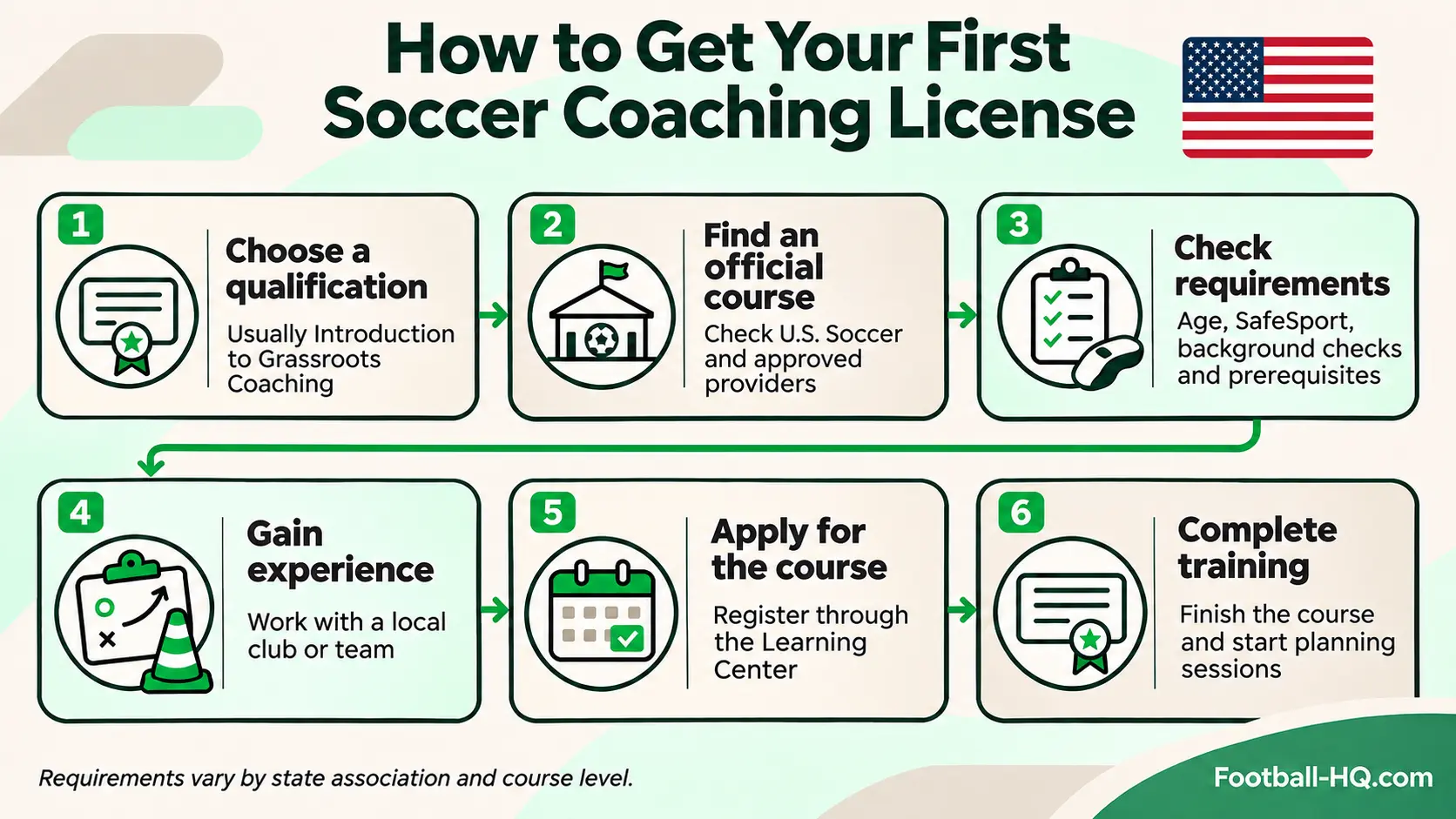
Step 2: Complete the free Introduction to Grassroots Coaching
The simplest way to begin is with U.S. Soccer's Introduction to Grassroots Coaching Module.
This free online module introduces the federation's coaching philosophy and explains how to create suitable learning environments for young players.
To get started:
- Visit the U.S. Soccer Learning Center.
- Create a free account or sign in.
- Open the available coaching courses.
- Find and complete the Introduction to Grassroots Coaching Module.
U.S. Soccer identifies this module as the recommended starting point for new coaches in its official licensing guidance.
You don't need to be coaching a competitive team to benefit from the introduction. It gives you a foundation for understanding how players learn and how training activities should relate to the game.
Once you've completed it, you can explore the Grassroots courses that fit the players you coach.
Step 3: Choose a Grassroots coaching course
U.S. Soccer's Grassroots courses are organized around four playing formats: 4v4, 7v7, 9v9 and 11v11.
Each format reflects a different stage of youth soccer development.
| Course | Typical age groups | Playing format |
|---|---|---|
| 4v4 | U6–U8 | Four players per team |
| 7v7 | U9–U10 | Seven players per team |
| 9v9 | U11–U12 | Nine players per team |
| 11v11 | U13 and older | Full-sided soccer |
These age groups follow U.S. Soccer's Grassroots coaching education guidance, although individual competitions may have their own playing-format rules.
Which Grassroots course should you take?
Choose a course that reflects the age group and format you're currently coaching.
For example, if you're helping with a U9 recreational team that plays 7v7, the 7v7 course is a practical starting point. It focuses on coaching situations relevant to that format rather than introducing advanced 11v11 tactics.
Grassroots education covers topics such as organizing training activities, understanding player needs, creating positive environments and helping children make decisions during games.
Courses are available in online and in-person formats. In-person education provides opportunities to work with other coaches and participate in practical activities.
If you plan to progress to the D License, check the required combination of Grassroots courses before registering. Completing one course is useful for your current coaching, but it does not necessarily satisfy the prerequisites for the next level.
Step 4: Check the requirements for your next license
Once you've completed the introductory requirements, you can begin working toward the national D License and potentially higher qualifications.
The D License is designed to help coaches organize training and game environments that support young players. It places particular emphasis on age-appropriate activities, player involvement and creating enjoyable learning experiences.
U.S. Soccer's published Grassroots pathway has required a combination of online and in-person Grassroots courses before entering the D License. The federation's member organizations provide current course eligibility information, including US Club Soccer's coaching education overview.
The requirements become more demanding as you progress.
For example, coaches applying for the C License generally need to be at least 18, hold the D License for a qualifying period and have access to an appropriate team for practical work. The Virginia Youth Soccer Association's course guidance describes these requirements and the progression toward B.
Higher licenses require further coaching experience and appropriate working environments. Some applicants may qualify for waivers based on recognized playing experience or previous coaching qualifications.
Check the eligibility rules in the Learning Center before applying. Your current experience, the license you already hold and the team you coach can affect which course you're eligible to take.
Do you need a license to coach youth soccer?
Not every youth soccer coaching position requires the same qualification.
According to U.S. Soccer's official guidance, specific licensing requirements are typically established by member associations, leagues and teams.
A volunteer helping with a recreational team may face different requirements from a coach working in a competitive youth academy.
Before applying for a license solely to meet a club requirement, ask the club or league which qualifications it recognizes.
Step 5: Meet the safety requirements and apply
Coaching education and permission to work with young players are related, but they are not the same thing.
Depending on your role, you may need safeguarding training, background screening and other clearances before participating in youth soccer.
In 2025, U.S. Soccer introduced its Safe Soccer Clearance Program, which brings together SafeSport training, safeguarding education and background checks.
The program is explained in U.S. Soccer's official announcement.
Check your club's requirements early, particularly if you're volunteering with children for the first time. Completing a coaching course does not automatically replace these obligations.
Where do you register for coaching courses?
The U.S. Soccer Learning Center is the main place to find and register for courses.
After signing in, open Courses and select Available Courses. You can browse the license pathway and filter available courses by location.
State associations and other U.S. Soccer member organizations host many Grassroots, D and C courses.
If you cannot find a course near you, that may simply mean no local dates have been scheduled. U.S. Soccer recommends contacting the relevant state or member association for more information.
For B, A-Youth and A-Senior courses, applications typically open during specific windows. These are not always available for immediate registration. The federation explains how these openings are announced in its course application FAQ.
Before registering, check the course fees, schedule, in-person attendance requirements and any practical assignments.
Step 6: Complete your training and gain coaching experience
Soccer coaching education involves more than watching presentations and learning drills.
Depending on the course, you may participate in practical sessions, complete assignments, work with other coaches and receive feedback on your training methods.
For example, the U.S. Soccer D License course uses a combination of in-person learning, virtual meetings and practical assignments. Coaches are expected to apply what they learn in their own coaching environments.
If you're not currently coaching a team, consider contacting a local recreational club and asking whether you can assist with training.
Starting as an assistant coach gives you opportunities to observe how sessions are organized, work with players and learn from someone more experienced.
A simple habit is to record what worked and what didn't after each practice.
Suppose you're coaching a U10 team and notice that players lose interest during a passing exercise. Rather than immediately replacing the drill, consider whether the players are waiting too long, the instructions are unclear or the activity offers too few decisions.
These observations help you improve your sessions and become more confident in your coaching decisions.
Common questions about soccer coaching licenses in the USA
How old do you need to be?
Minimum age requirements depend on the course.
U.S. Soccer's national coaching policies establish a minimum age of 16 for the D level and 18 for C, B and A courses, although course-specific eligibility conditions must also be checked.
Younger coaches may be able to begin introductory education before becoming eligible for more advanced qualifications.
If you're under 18, check your club's supervision requirements before taking responsibility for a youth team.
How much does a soccer coaching license cost?
The Introduction to Grassroots Coaching Module is free.
Other courses have fees that vary by level, provider and location. In-person training may also involve travel or accommodation costs.
Rather than relying on a general price estimate, check the current registration page for the course you're considering.
Some associations and coaching organizations offer scholarships or financial assistance. Availability and eligibility vary.
Are United Soccer Coaches diplomas the same as U.S. Soccer licenses?
No. United Soccer Coaches is a professional coaching organization offering its own education programs and diplomas.
These qualifications can provide valuable coaching education, but they are separate from the official U.S. Soccer licensing pathway.
Some clubs or organizations may recognize qualifications from both systems. Always check which credential is required for the position you want.
Can you use a UEFA coaching license in the United States?
A UEFA qualification may be considered when applying for U.S. Soccer coaching education or certain coaching positions, but recognition is not automatic.
U.S. Soccer has waiver procedures for applicants with qualifying foreign coaching credentials. Requirements depend on the course and the credential held.
If you've qualified in Europe, contact U.S. Soccer or the relevant course organizer before assuming you need to restart the entire pathway. You can also read our UEFA coaching licence application guide to understand how the European system differs.
Where should you begin?
If you're completely new to coaching, start with the free Introduction to Grassroots Coaching Module and find opportunities to help with a local soccer team.
If you're already coaching, choose the Grassroots course that matches your players and check whether you meet the requirements for the next license.
You can also start planning your practices before earning your first qualification. FootballHQ's free drill creator lets you draw soccer drills and prepare activities for your next training session.