
Can You Coach Football Without a Licence? Rules Explained

Yes, you can coach football without a formal coaching licence in some circumstances, particularly as a grassroots volunteer or assistant. However, the rules depend on your country, the level of football and the responsibilities you take on.
A licence is not always necessary to help at training, but becoming the registered coach of a team may involve additional requirements. These can include introductory coaching qualifications, safeguarding training, background checks and registration with a football association.
There is no single rule covering every country or competition. Before taking responsibility for a team, you should understand the difference between what is legally permitted and what your club or league requires.
Can you volunteer at a football club without a licence?
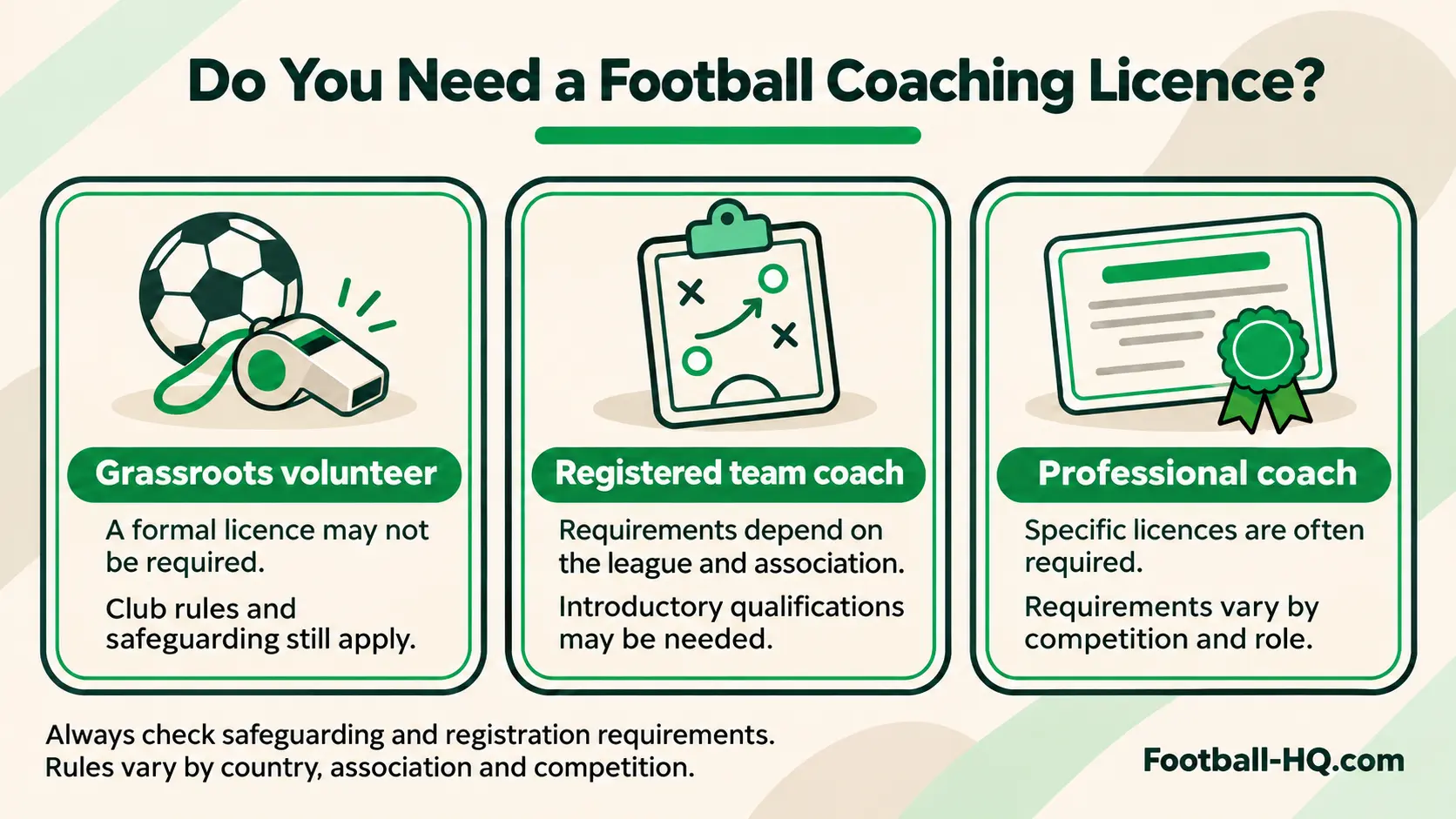
Coaching licence requirements vary by role, country and competition. Safeguarding and registration requirements may apply even when a formal licence is not necessary
Many grassroots clubs welcome volunteers who have never completed a formal coaching course. Parents, former players and other members of the community often begin by helping an existing coach.
You might prepare equipment, organise small activities, help demonstrate exercises or assist with matchday arrangements. These responsibilities can provide useful experience without immediately committing to a lengthy coaching qualification.
However, being allowed to assist does not necessarily mean you can become the team's registered head coach. Some clubs must appoint someone with a recognised qualification, even if other volunteers are allowed to help.
The distinction matters. A volunteer supporting a qualified coach may face different requirements from someone independently planning sessions, supervising children or representing the team during official matches.
Clubs may also require new volunteers to complete safeguarding checks or basic training before working with players. These requirements can apply even when no advanced coaching licence is needed.
When is a coaching licence required?
Formal qualifications become more important as coaching responsibilities increase, although the exact requirements depend on the competition.
At grassroots level, some associations allow adults to coach without holding a formal licence. Others require introductory education or ensure that each youth team has at least one qualified coach.
Competitive youth leagues may set higher standards. Clubs might need coaches with particular qualifications to register teams, enter competitions or maintain their accreditation.
Professional football generally has more demanding requirements. For example, UEFA's 2026 Club Licensing and Financial Sustainability Regulations require first-team head coaches at clubs subject to those regulations to hold a valid UEFA Pro licence, a UEFA A licence where the applicable association is not a Pro-level convention signatory, or recognised equivalent competence.
Those regulations apply within UEFA's club licensing framework. They do not mean everyone helping at a European grassroots club needs a UEFA qualification.
For an explanation of the different levels, see our guide to UEFA C, B, A and Pro coaching licences.
How do coaching requirements differ between countries?
National football associations establish their own coaching education and registration requirements. Individual competitions and clubs may impose additional conditions.
The following examples show why you should check the rules for your particular role rather than assuming that one country's requirements apply elsewhere.
England
In England, the requirements depend partly on whether a club is England Football Accredited and which teams it operates.
The FA's accreditation criteria require accredited clubs with youth teams to have at least one coach or manager per team who has completed Introduction to Coaching Football or an accepted equivalent. Relevant first-aid and safeguarding education is also part of the criteria.
The FA's 2026–27 club affiliation requirements additionally require named youth team coaches and managers to have accepted, in-date DBS checks and to complete the Safeguarding Children Course.
This means you may be able to begin by assisting at a grassroots club without holding a UEFA licence, but you cannot assume that an unqualified volunteer can fulfil every official coaching role.
Wales
Wales provides a useful example of how requirements can differ even within the same country.
According to the Football Association of Wales, coaches and team managers in grassroots adult football do not need a formal coaching qualification for that role. They do need confirmed registration through the FAW's COMET system.
For grassroots junior football, the FAW specifies the Football Leaders Award and an enhanced DBS check as minimum requirements for coaches and team managers.
The distinction shows why it is important to check the age group you intend to coach, not simply whether a country's football association offers introductory courses.
United States
In the United States, the question is usually whether you need a soccer coaching license.
U.S. Soccer's official guidance explains that specific licensing requirements are generally established by member associations, leagues and teams.
A volunteer coach in a recreational youth league may therefore face different requirements from someone coaching in a competitive development programme.
U.S. Soccer recommends beginning with its free Introduction to Grassroots Coaching Module, available through the U.S. Soccer Learning Center. Further education includes Grassroots courses and D, C, B, A and Pro licences.
If you're based in the United States, our guide to getting a soccer coaching license in the USA explains the pathway and how to register.
Spain
Spain's Royal Spanish Football Federation (RFEF) links coaching qualifications to the competition and the position a coach holds.
The RFEF's 2025–26 national competition guidance outlines different qualification requirements for head coaches, assistant coaches, goalkeeper specialists and physical preparation staff.
The required level varies across competitions. Regional football associations also have responsibilities for competitions and coaching education within their territories.
If you want to coach in Spain, check the current regulations for your division and position. Do not assume that being eligible to help at a local club means you can register as the official head coach of a competitive team.
Is it legal to coach football without qualifications?
There is no single international law requiring every football coach to hold the same licence. However, that does not mean anyone can coach in any setting without restrictions.
Three different types of rules may apply:
- National and local law: Legal requirements can affect employment, working with children, background screening and the operation of sports activities.
- Football association and league regulations: These determine which qualifications or registrations are needed for particular teams, competitions and coaching positions.
- Club requirements: A club may require additional education, safeguarding checks or experience before allowing someone to lead training.
A person might be legally permitted to assist with a football activity but still be ineligible to register as a coach in a particular league.
Likewise, holding a coaching licence does not automatically satisfy every legal, safeguarding or employment requirement.
The most reliable approach is to ask the club or competition organiser which rules apply and consult the relevant national association's current guidance.
Do you need safeguarding training or a background check?
Coaching qualifications and safeguarding clearance are separate requirements. You may not need a UEFA or U.S. Soccer licence to volunteer, but that does not exempt you from child-protection rules.
In England, the FA's safeguarding guidance explains when an enhanced Disclosure and Barring Service (DBS) check is required for people working with under-18s. Clubs must ensure that individuals in eligible roles have appropriate clearance before working unsupervised with children.
In the United States, U.S. Soccer's Safe Soccer Clearance Program combines SafeSport training, safeguarding education and background screening to support safer participation in youth soccer.
Other countries have their own systems, and individual clubs may have further policies covering supervision, first aid and volunteer registration.
Always complete the required safeguarding procedures before taking on responsibilities involving children. Being a parent of a player, volunteering without pay or having previous playing experience does not automatically remove these obligations.
How can you start coaching without a licence?
If you have little or no coaching experience, assisting at a grassroots club is often a practical way to begin.
- Contact a local club. Explain that you're interested in volunteering and ask whether it needs assistant coaches.
- Check the requirements. Ask about registration, safeguarding, background checks and introductory qualifications.
- Begin with supervised responsibilities. Help organise exercises, observe experienced coaches and gradually take on more tasks.
- Complete introductory education. Choose a course recognised by the association or league where you intend to coach.
- Build practical experience. Learn how to communicate with players, organise activities and adjust sessions to different abilities.
You don't need to wait until you've earned an advanced licence to start learning how to coach. However, you should only take responsibility for activities that the club has authorised you to perform.
If you're working towards formal qualifications, our guide to getting a UEFA coaching licence explains how to find courses and apply through national associations.
Is getting a coaching licence worth it if it isn't required?
For many grassroots volunteers, introductory coaching education is worthwhile even when it is not compulsory.
A good course can help you understand how to organise practices, keep players involved and give instructions that are appropriate for their age and ability. It also provides a chance to receive feedback on your coaching.
Formal qualifications become more valuable if you intend to move into competitive youth football, paid coaching or professional development roles. They can help you meet eligibility requirements and provide a structured way to develop your skills.
However, a qualification alone does not make someone an effective coach. Practical experience, communication and the ability to respond to players are equally important parts of coaching development.
Where should you begin?
If you want to volunteer at a local club, ask which responsibilities you can take on and what checks or courses are required. You may be able to start without a formal licence, but the club should confirm this before you begin.
If you want to become the registered coach of a team, check the requirements of your football association and competition first. That will help you avoid paying for a qualification you do not need or applying for a position you are not yet eligible to hold.
You can also start developing your practical coaching skills by preparing simple training activities. FootballHQ's free drill creator lets you draw football exercises and plan activities before taking them onto the pitch.